Five years ago, telling someone at the trailhead that I was loading a Bakcou into my truck for opening day got a confused look or a smart remark. Now half the trucks at the same trailhead have an ebike rack on the back. The shift happened fast, and a lot of hunters are still trying to figure out whether the bikes are worth the money and how to actually use one in the woods.
This guide is the answer I wish someone had given me when I was researching my first bike. I’m going to cover what a hunting ebike actually is, why hunters are switching, how to pick your first one without buying twice, what gear you need, how to ride for hunting (not recreation), and the legal stuff that catches people off guard.
It’s long because the topic deserves it. Skim what doesn’t apply to you. Read what does.
What a Hunting Ebike Actually Is
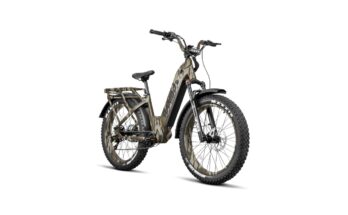
A hunting ebike is a fat-tire electric bicycle, usually with a 750W to 1,000W motor, that’s been built or modified for off-road backcountry use. The “hunting” part isn’t marketing fluff. The bikes are heavier, more durable, and rated for higher payloads than typical commuter or trail ebikes. They run thicker frames, beefier brakes, fatter tires, and bigger batteries.
What separates a hunting ebike from a regular ebike:
- Payload capacity around 300 to 400 pounds (a hunter plus gear plus meat)
- Camo finishes or wraps that break up the silhouette
- Mounts for guns, bows, panniers, and game cart hitches
- Tuning for low-speed torque rather than top speed
- Components that survive mud, snow, and rough roads
A hunting ebike is not a substitute for an ATV. It doesn’t haul as much, doesn’t tow as much, doesn’t go through the same terrain. What it does is move quietly, weigh under a hundred pounds, and squeeze through gates and trails that an ATV can’t. The right way to think about it: an ebike is what you ride where an ATV can’t go and a foot hunter can’t cover enough ground.
Why Hunters Are Switching
Four reasons, mostly.
Access. Public-land hunting is a competition for two things: the animals, and the access roads that get you to them. Walk in too slow and the guys with bikes beat you to the spot. Drive an ATV where ATVs aren’t allowed and you get a ticket. An ebike fits the access window where motors are restricted but bicycles are allowed. In a lot of national forest and BLM units, that’s the difference between hunting and tagging out.
Range. A reasonable hunter on foot covers two to four miles in a hunting day at a sustainable pace. The same hunter on a bike covers 15 to 25 miles without breaking a sweat. That changes what you can do in a morning. You can hunt three different ridges instead of one. You can come back for the bird you didn’t get the first time. You can scout twice the country on a one-day trip.
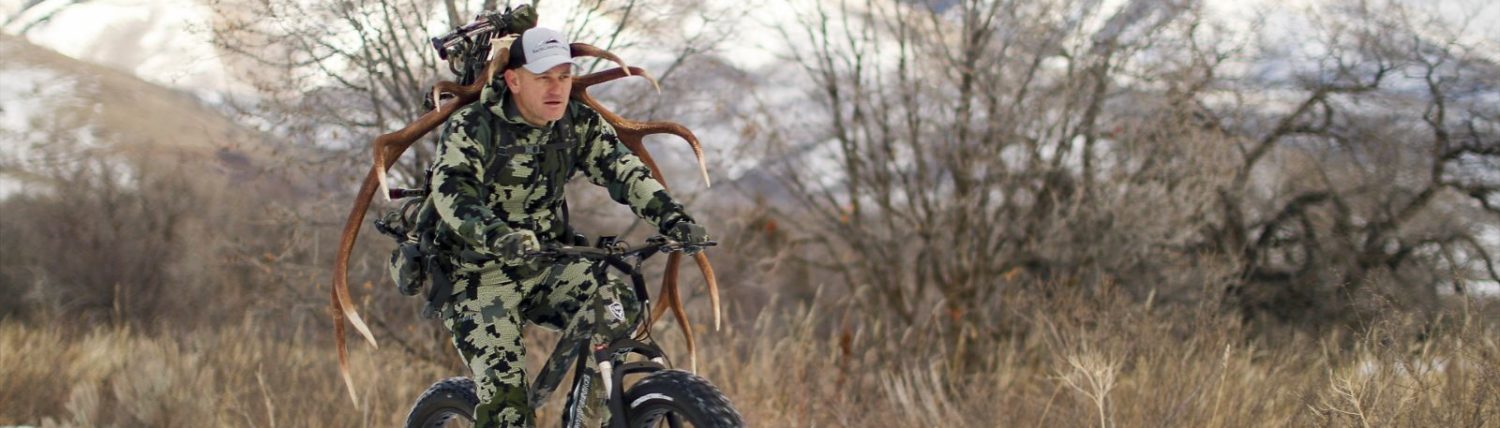
Pack-out. Anyone who has dragged a whitetail out of a holler or quartered an elk three miles from the truck understands this one. The bike turns a one-and-done pack into a half-hour ride. I’ve personally moved a quartered mule deer two and a half miles from the kill site to the truck on a Bakcou in under 45 minutes. Two trips. No regrets.
Stealth. A quality mid-drive ebike at low assist is quieter than walking through dry leaves. You can ride within a few hundred yards of a stand without setting off the woods. Game animals key on consistent mechanical sound (ATV engines, side-by-sides), and the lack of one is exactly what your ebike is doing.
The Case Against, While We’re Being Honest
An ebike isn’t for everyone. If you hunt private land you can drive a truck to, you don’t need a bike. If your terrain is genuinely rugged backcountry only reachable by horse or foot, an ebike won’t help. If you’re a once-a-year hunter who isn’t going to put 100 miles a year on the bike, the math doesn’t work. Spending $3,000 on a tool you use eight days a year is a tough sell.
Where the ebike earns its money: hunters who walk more than two miles to their setup, hunters who hunt public land where access matters, hunters on big farms with multiple stands far apart, and hunters who hate the pack-out part of hunting.
How an Ebike Actually Works
You’re getting a battery (usually 720Wh to 1,000Wh), a controller, a motor, and a drivetrain. When you pedal, the motor adds assist proportional to how hard you’re pedaling or how high you set the assist level. Most hunting ebikes also have a throttle, so you can ride without pedaling, though range drops significantly when you do.
Two main motor types.
Hub motors sit in the rear wheel. They’re simpler, cheaper, and quieter at low speeds. They struggle on steep grades because they can’t use the bike’s gears. Fine for flat to rolling terrain. Examples in the hunting world: Himiway Cobra D7, most QuietKat Ranger XR variants.
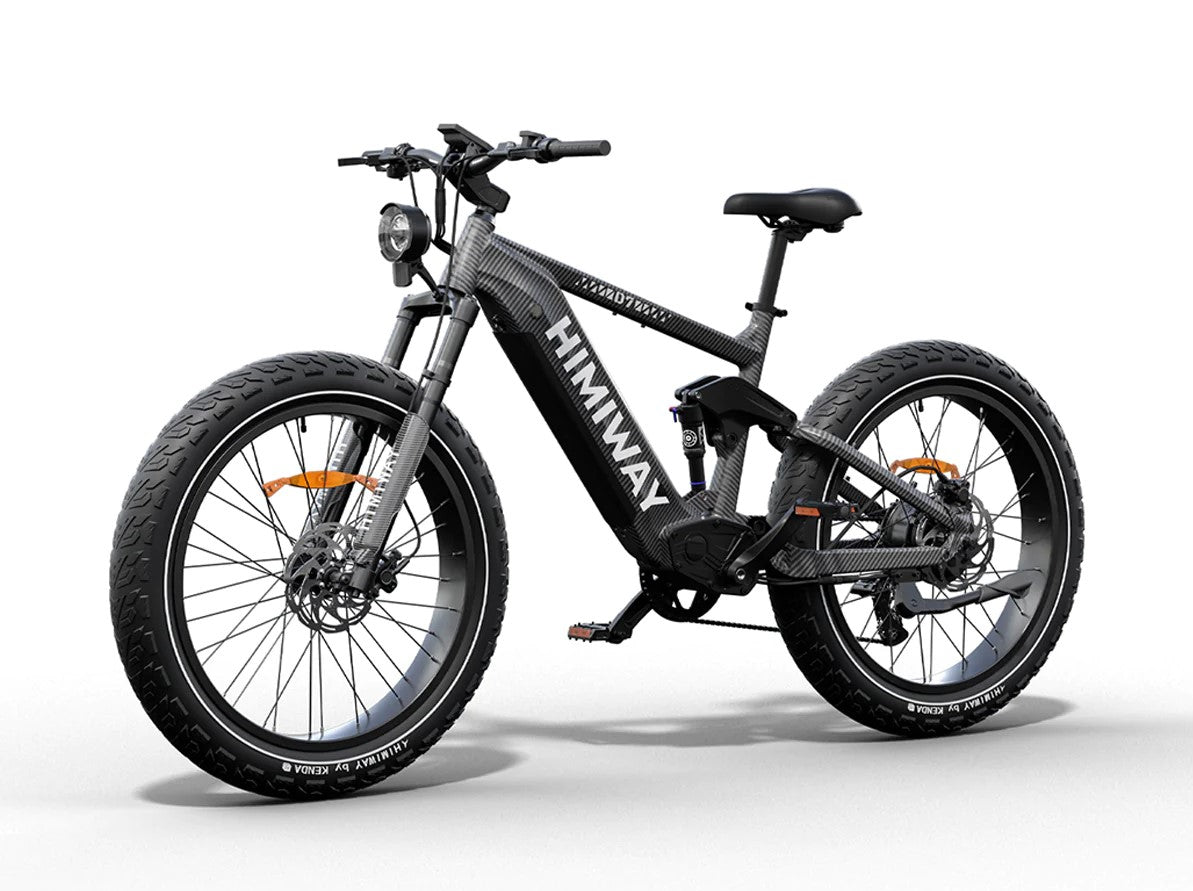
Hub-motor example: Himiway Cobra D7
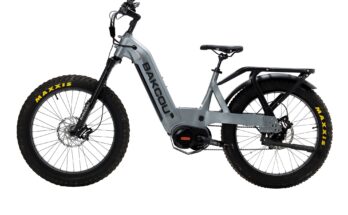
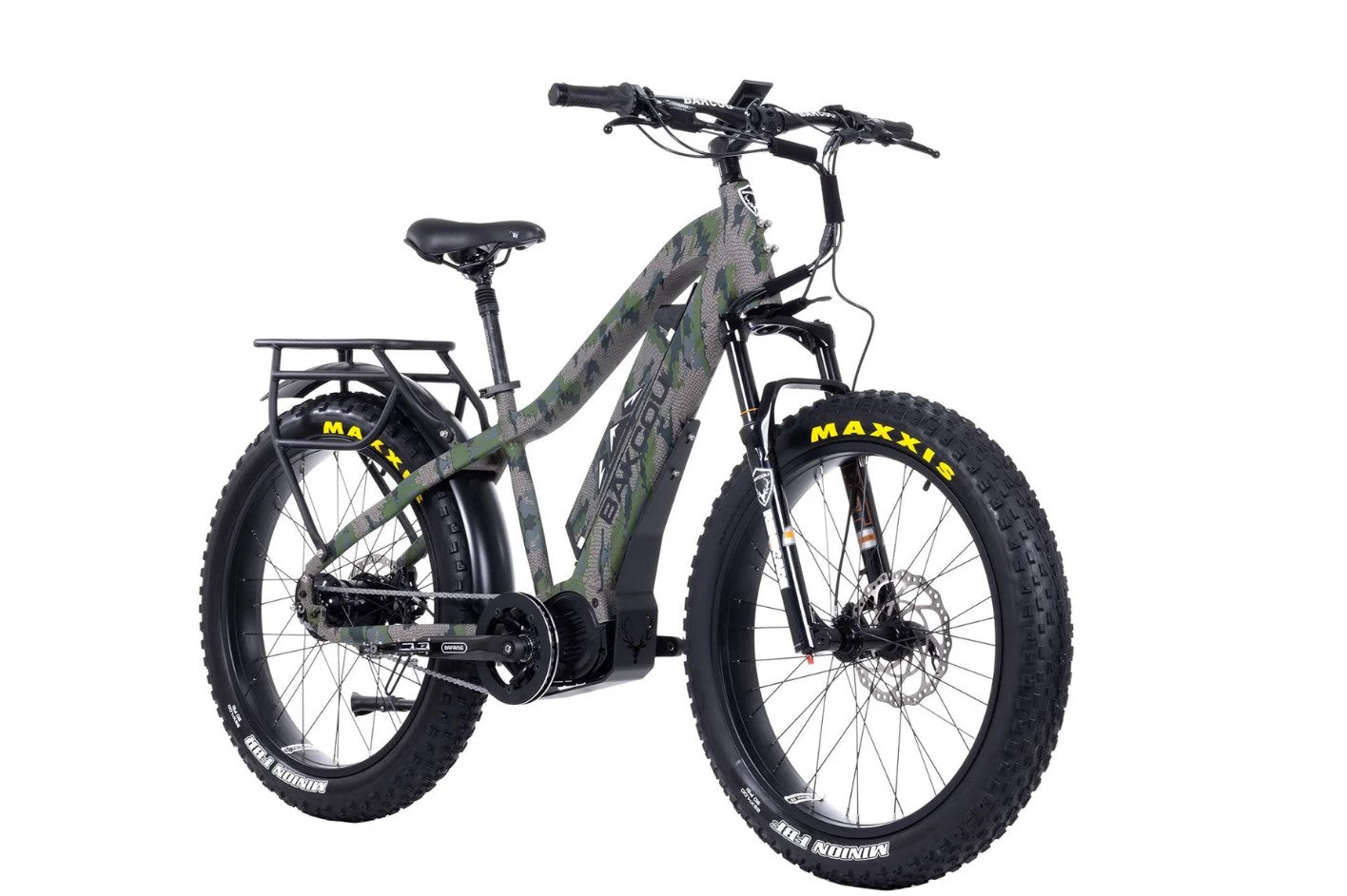
Mid-drive motors sit at the bottom bracket and drive the chain through the bike’s gears. They climb dramatically better than hub motors because the gears give the motor mechanical advantage. They’re more efficient on hills, but they wear chains faster and cost more. Examples: Bakcou Mule SD, Rambo Roamer 2.0, QuietKat Apex XD.
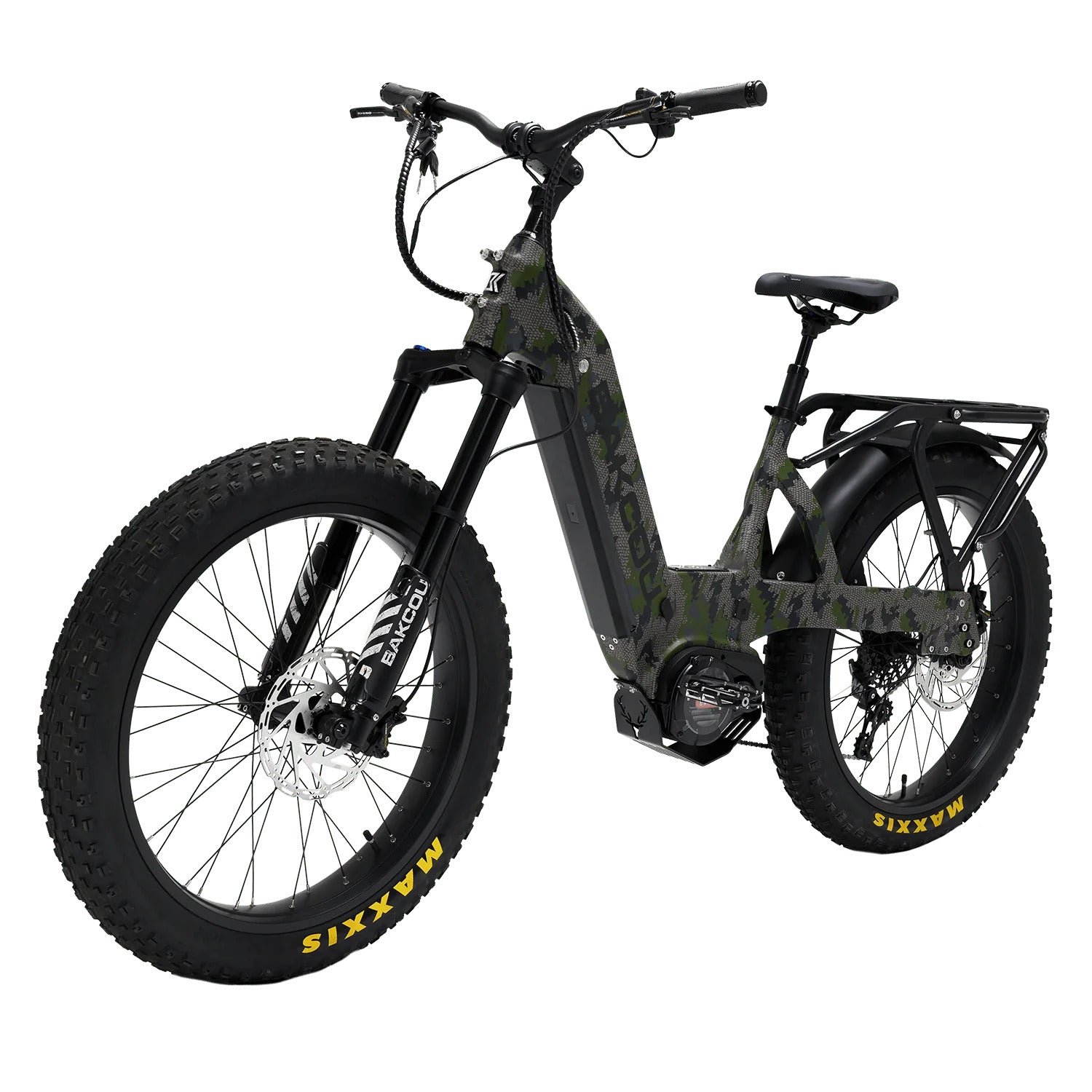
Mid-drive example: Bakcou Mule SD
If your hunting is flat to rolling, a hub motor is fine and saves you money. If you’re climbing meaningful elevation, get a mid-drive. The difference shows up the first time you grind up a real hill.
There’s also a third option getting more common: AWD (dual motor, one front and one rear). It costs more, weighs more, draws more battery, and trades all of that for traction on side-hills, mud, and snow. Worth it if your terrain demands it, overkill if it doesn’t. The dual-motor guide goes deeper on AWD specifically.
Ebike classes. Ebikes are legally categorized in three classes:
- Class 1: pedal-assist only, max assist 20 mph
- Class 2: pedal-assist plus throttle, max 20 mph
- Class 3: pedal-assist only (sometimes with throttle), max 28 mph
Most hunting ebikes are Class 2 with a throttle. Some can be programmed to higher classes. The class matters for where you can ride legally. More on that below.
Picking Your First Bike
Here’s the framework I give every hunter who asks. Answer these four questions before you spend a dollar.
1. What’s your budget? The honest entry point for a hunting ebike that won’t disappoint is around $2,000. We covered the cheap tier in the under-$2,000 roundup and the mid-range in the under-$3,000 roundup. Above $3,500 you’re into premium Bakcou and high-end QuietKat territory.
2. What’s your terrain? Flat to rolling: hub motor is fine. Steep climbs: get a mid-drive. Mud, snow, side-hill country: look at AWD options.
3. What are you hunting? Whitetail from stands within a couple miles of the truck: any decent bike works. Western big game in the backcountry: get a real bike with range and payload. Turkey or small game on foot-access ground: you can save money. See the species guides for deer, elk, and turkey for specifics.
4. What’s your range need? Day hunts close to the truck: 25 miles of range is plenty. Multi-day backcountry: get the biggest battery you can afford or plan to carry a spare.
The two-bike-buyer mistake is real. Plenty of guys buy a $1,500 bike, hate one specific thing about it within six months, and end up buying a $3,500 bike anyway. If you can afford the mid-range pick on your first purchase, do it. The bikes hold value reasonably well and you won’t outgrow them as fast.
If you’re choosing between the two biggest names in the hunting market, the QuietKat vs Bakcou comparison covers the differences in depth.
Gear That Actually Matters
The bike is just a platform. Where you turn it into a hunting tool is in the accessories.
Must-haves:
- A rear rack rated for at least 50 pounds (most hunting bikes come with one)
- A gun or bow mount (Bakcou makes one, Kolpin Stronghold also works)
- Panniers for gear (Bakcou and aftermarket options both exist)
- A spare tube and basic tool kit
- A way to lock the bike at the trailhead
Nice-to-haves:
- A spare battery for full-day backcountry hunts
- A game cart trailer for big animals (see the deer hauling guide)
- A handlebar mount for phone or GPS
- Headlight that works for pre-dawn rides on dark roads
- Trailer hitch if you’ll pull a cart
Skip until you need them:
- Fancy suspension upgrades (most hunting riding doesn’t need them)
- Carbon fiber anything (heavy use breaks it)
- Aftermarket motor controllers (they void warranties)
How to Ride Differently for Hunting
Most ebike content is written for recreational riders. Hunters need to think about a few things they don’t.
Speed. Recreational riders push speed. Hunters keep it slow on the approach, faster on the connector roads. The bike’s not a race bike. Cruising at 8 to 12 mph on a forest road preserves battery, keeps the motor quiet, and lets you actually see and hear what’s around you.
Light discipline. Pre-dawn approaches require either a dim red light or no light at all on the bike. Headlights that throw white light a hundred yards down a road will spook everything. I use a handlebar light on red mode for the close roads I know and ride blind on familiar two-tracks.
Sound discipline. Crap rattling around in your panniers makes more noise than the motor. Pack tight, use foam padding, and don’t carry anything loose. The bike is quieter than your gear, so make sure your gear is quiet.
Wind direction. Same as foot hunting. Approach from downwind. Plan your loops so the wind isn’t carrying your scent to the spots you’re hunting next.
Where to stash the bike. Lay it on its side off the trail in low brush, fifty to a hundred yards from your setup. A camo finish or a camo wrap helps a lot here. A bike leaning against a tree is a vertical silhouette that game can pick up at distance. Lay it flat.
Where You Can and Can’t Ride
This is where ebike hunting gets complicated and where new hunters get tickets.
Federal land (BLM, national forest, etc.): ebikes are generally treated similar to motorized vehicles on the access road network. You can ride them on roads open to motorized travel, including forest service roads, gated multiple-use roads, and most two-tracks. You cannot ride them on most singletrack hiking trails. Federal agencies have moved toward allowing ebikes where traditional bicycles are allowed, but individual forests and field offices set their own rules. Always check the local travel management plan before you ride.
Wilderness areas: never. Wheels are prohibited in designated Wilderness by federal law. This is not negotiable, not enforced lightly, and not worth the ticket. There is plenty of non-Wilderness public land where you can ride.
State land: varies wildly. Some states classify ebikes as bicycles on multi-use trails. Others lump them with motor vehicles. A few states have specific ebike-hunting regulations. The updated 50-state regulations breakdown covers the current rules.
Private land: you ride what the landowner allows. If you’re on a lease or have permission, ask before you bring the bike.
During hunting season specifically: some states restrict motorized travel during certain seasons, even on roads otherwise open to vehicles. Colorado is notorious for this with GMU-specific motorized closures during deer and elk seasons. Read your state’s hunting regulations every year, not just the general travel rules.
The Pack-Out
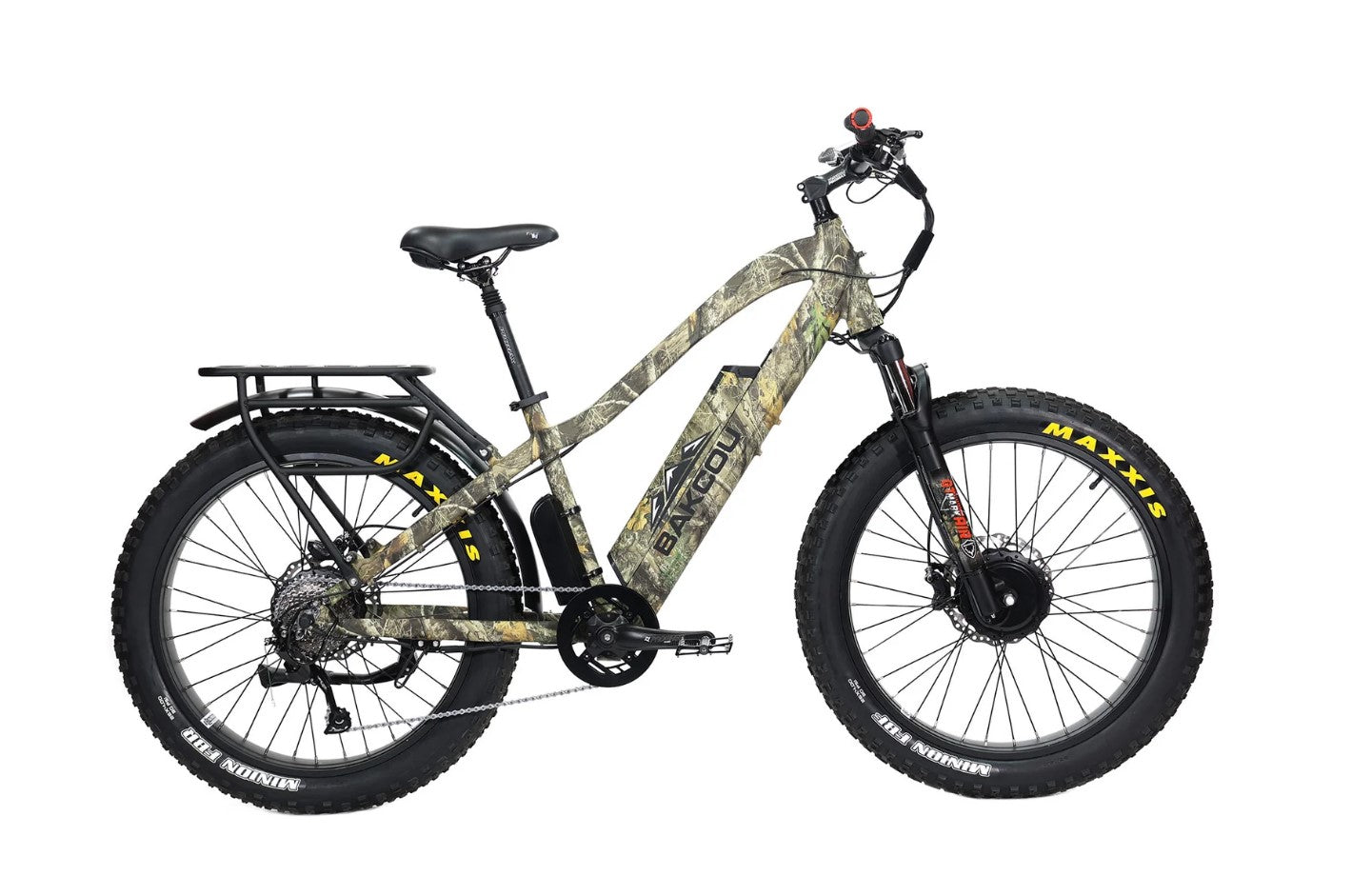
The pack-out is where the bike pays its tuition. AWD models like the Bakcou Kodiak help on loaded climbs out.
For a deer or smaller animal, quartered or whole, you can strap most of it directly to the rack and back-of-pannier rigging. For a quartered elk, you’ll likely need a game cart or trailer. The hauling deer with an ebike guide gets into specifics.
Two principles to internalize:
- Don’t overload the bike. A 400-pound payload rating includes you. If you weigh 200, you have 200 left for gear and meat. Most hunters underestimate their own weight plus gear weight.
- Ride slow on the way out. A loaded bike handles differently. Brake earlier. Take corners slower. Don’t try to ride the pack-out at the speed you rode in.
The pack-out is where guys get hurt on these bikes. Tired hunter plus heavy load plus rough road plus low light is when crashes happen. Take your time.
Maintenance and Battery Care
Hunting bikes get put away wet and dirty. They live outside truck beds and trailer racks. They go from heat to cold to mud to dust. They get more abuse than a daily commuter does.
A few things to do that will double the bike’s lifespan:
- Wipe the chain and drivetrain after every wet ride. A bottle of degreaser and a rag takes five minutes.
- Check tire pressure before every hunt. Fat tires lose pressure fast in cold weather.
- Inspect brake pads quarterly. Hydraulic brakes wear pads silently until they’re metal-on-metal.
- Charge the battery between 30% and 80% for storage. Lithium batteries hate sitting full or empty for months.
- Keep the battery out of extreme heat and cold when not in use. Don’t leave it in a truck bed in Phoenix in August or in an unheated garage at zero degrees Fahrenheit.
- Lubricate the chain with the right lube for your conditions (wet lube for muddy hunts, dry lube for dusty western country).
The hunting ebike maintenance guide covers the full routine in depth.
Common Rookie Mistakes
I’ll close with the things I see new ebike hunters do that cost them money or success.
Buying the cheapest bike. $1,200 ebikes are for going to the grocery store. They will not handle a season of hunting use. Save up for a real one.
Buying the most expensive bike. A $7,500 Bakcou is a phenomenal bike, but if you’re hunting flat Midwest farmland from a stand a half mile from the truck, you don’t need it. Match the bike to the hunting.
Riding fast at first light. You’re not commuting. Slow down. The bike is a tool for getting to a spot quietly, not for showing off how fast it goes.
Not lubing the chain. Dry chains wear out drivetrains. A new chain is $30. A new cassette and chainring is $300.
Not checking local regs. The fine for an ebike on a closed trail in some states is more than the bike payment. Read the rules.
Storing the battery wrong. Two seasons of leaving the battery on the charger or completely dead in storage will kill it. New batteries are $700.
Showing up unfamiliar with the bike. Don’t take a brand-new bike to opening day. Ride it for a week first on your local trails. Figure out the controls, the assist levels, the braking, the loading. Opening morning is not the day to learn that your headlight button is buried in a menu.
Where to Go From Here
If you’re still researching, start with the main best-of guide for current overall picks, then narrow by price tier (under $2,000, under $3,000) or by category (fat tire, off-road, AWD).
If you’ve already picked a brand, the QuietKat vs Bakcou comparison goes deeper on the two biggest names.
If you know what you’re hunting, the species guides for deer, elk, and turkey cover the specifics.
If you’re ready to buy, the updated state regulations page is required reading before you ride a single mile.
Hunt safe, ride smart, and don’t drag your kill out by hand if you have an ebike in the back of the truck.