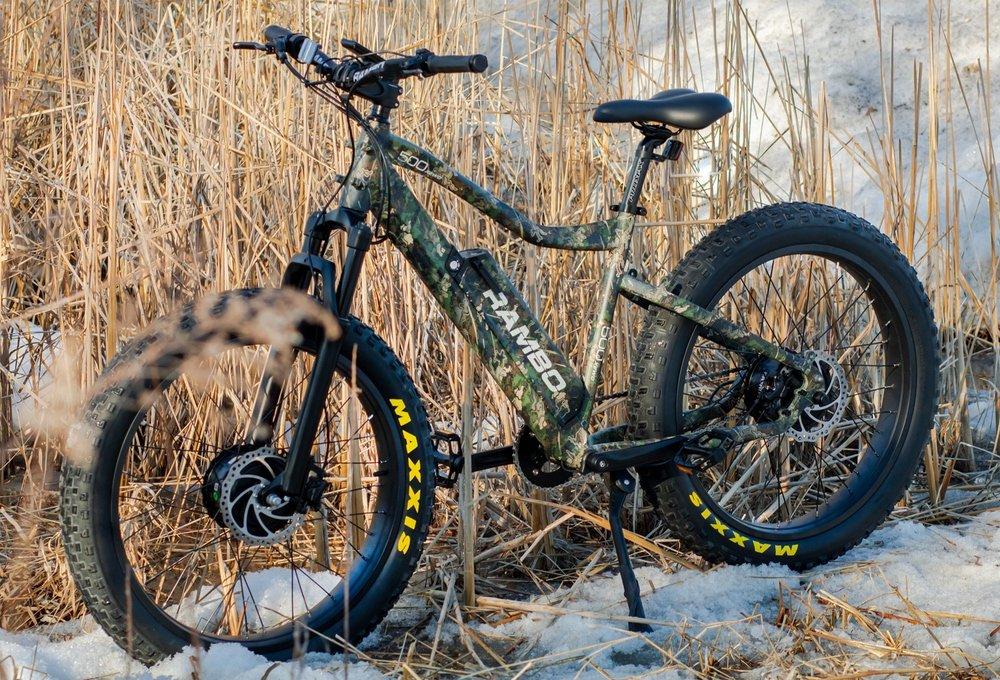
If you’ve spent any time riding a single-motor eBike up a muddy mountain trail in November, you’ve had the moment. The rear tire spins, the front end washes out, and you’re walking your expensive electric bike up the hill like it’s a shopping cart with a bad wheel. That’s when you start Googling “AWD electric bike” and “dual motor eBike.” Let’s talk about whether they’re actually worth the money for hunting.
How AWD and Dual Motor eBikes Work
The concept is straightforward. A standard eBike has one motor, either a hub motor in the rear wheel or a mid-drive motor at the crankset. An AWD or dual motor eBike adds a second motor, typically a hub motor in the front wheel, so both wheels are driven.
There are two common configurations. The first is dual hub motors: one hub motor in each wheel. This is the simpler and more common approach. Each motor drives its respective wheel independently, and in most setups, you can choose to run one motor or both. The second is mid-drive plus front hub: a mid-drive motor at the cranks (which benefits from the bike’s gearing) combined with a front hub motor. This setup gives you the torque advantages of mid-drive with the traction benefit of front-wheel power.
Most AWD systems are not true all-wheel-drive in the automotive sense. There’s no differential, no traction control system distributing power based on grip. Both motors simply receive power simultaneously. Some higher-end controllers allow you to adjust the power split between front and rear, but the majority of systems are straightforward: both motors on, or one motor on.
When You Actually Need AWD
This is where you need to be honest with yourself about where and how you hunt. AWD is not a universal upgrade. It solves specific problems, and if you don’t have those problems, you’re carrying extra weight and complexity for no benefit.
Steep, Loose Terrain
If you’re hunting mountain country with sustained steep grades on loose shale, sand, or decomposed granite, AWD makes a legitimate difference. When the rear tire breaks loose on a climb, the front motor keeps pulling you forward. If your hunting area includes grades over 15-20% on loose surfaces, AWD is worth serious consideration.
Mud and Snow
Deep mud and snow are where single-motor eBikes struggle the most. The rear tire digs in and spins, the front tire plows, and you’re going nowhere. AWD won’t turn your eBike into a snowmobile, but it significantly improves traction in conditions where a single drive wheel can’t maintain grip. If you hunt areas where early-season mud or late-season snow is a regular feature, AWD earns its keep.
Heavy Loads on Rough Trails
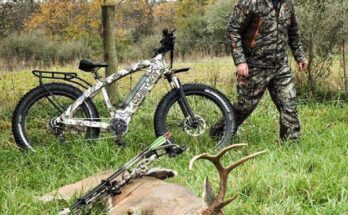
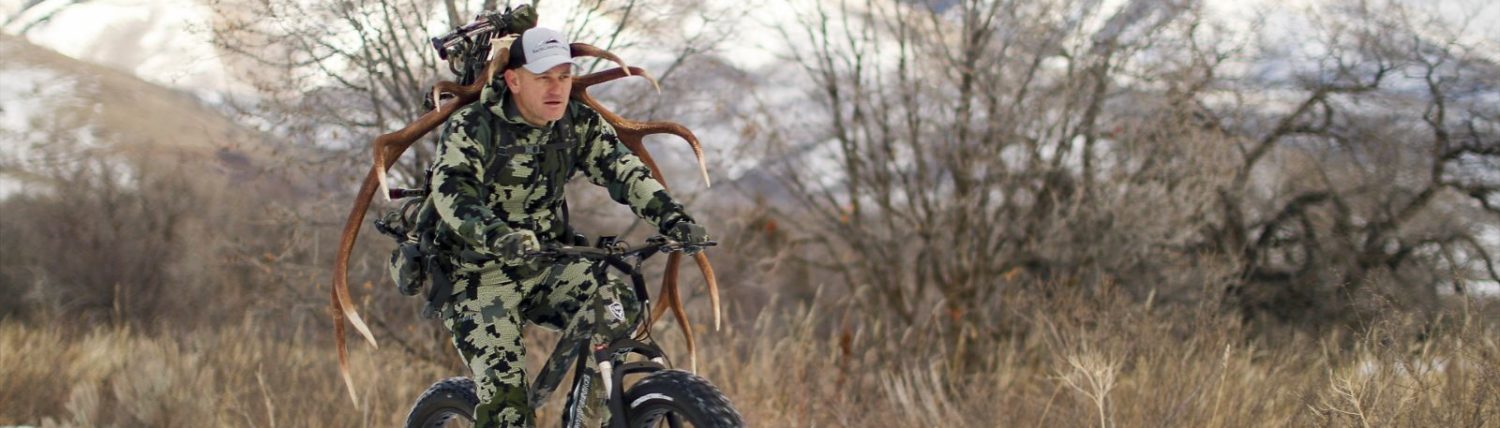
Towing a game cart loaded with a mature elk or mule deer up a rutted trail puts enormous strain on a single motor. The rear tire is working overtime for traction while carrying a significant tongue weight from the trailer. A front motor distributing some of that workload improves traction and reduces strain on the drivetrain. If you regularly haul heavy loads in rough terrain, AWD provides practical benefits.
When You Don’t Need AWD
If you hunt relatively flat ground, ride established trails or roads, and deal with moderate terrain, a quality single-motor eBike (especially one with a mid-drive motor and fat tires) will handle everything you throw at it. Most whitetail hunting in the Midwest and East doesn’t require AWD. Most turkey hunting doesn’t require AWD. If your trails are maintained two-tracks or fire roads, AWD is overkill.
Current AWD and Dual Motor Models for Hunting
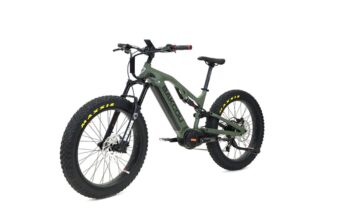
Bakcou Kodiak SD AWD
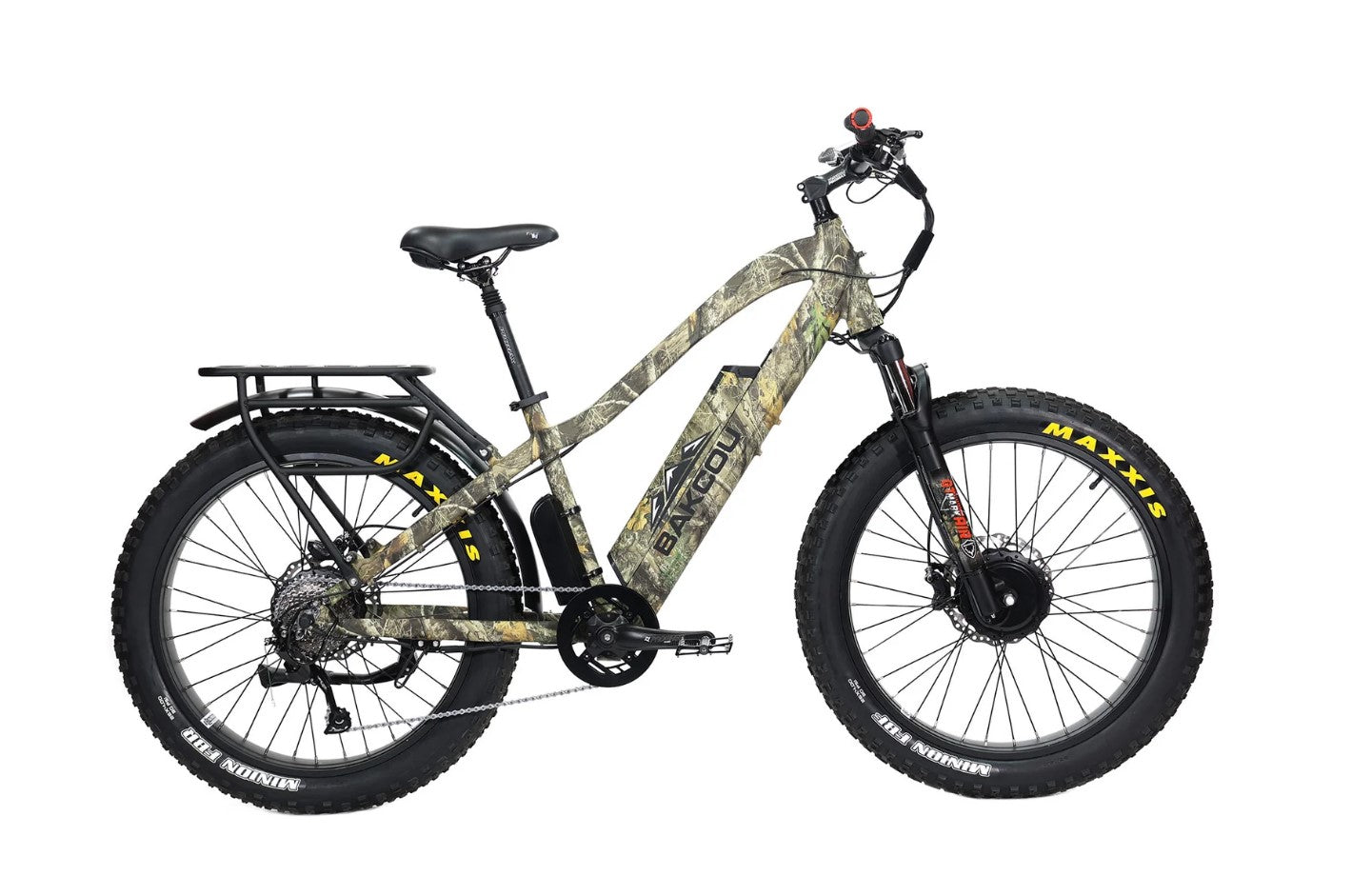
Bakcou Kodiak SD AWD – $4,199
The Kodiak SD AWD ($4,199) is Bakcou’s dedicated AWD offering, giving you the option to run single motor for easier terrain and engage the front motor when conditions demand it. Bakcou’s build quality and hunting-specific design make these solid options for serious backcountry hunters. The ability to switch between single and dual motor modes is practical for extending battery range on easier sections of your ride.
Rambo Krusader 3.0 AWD
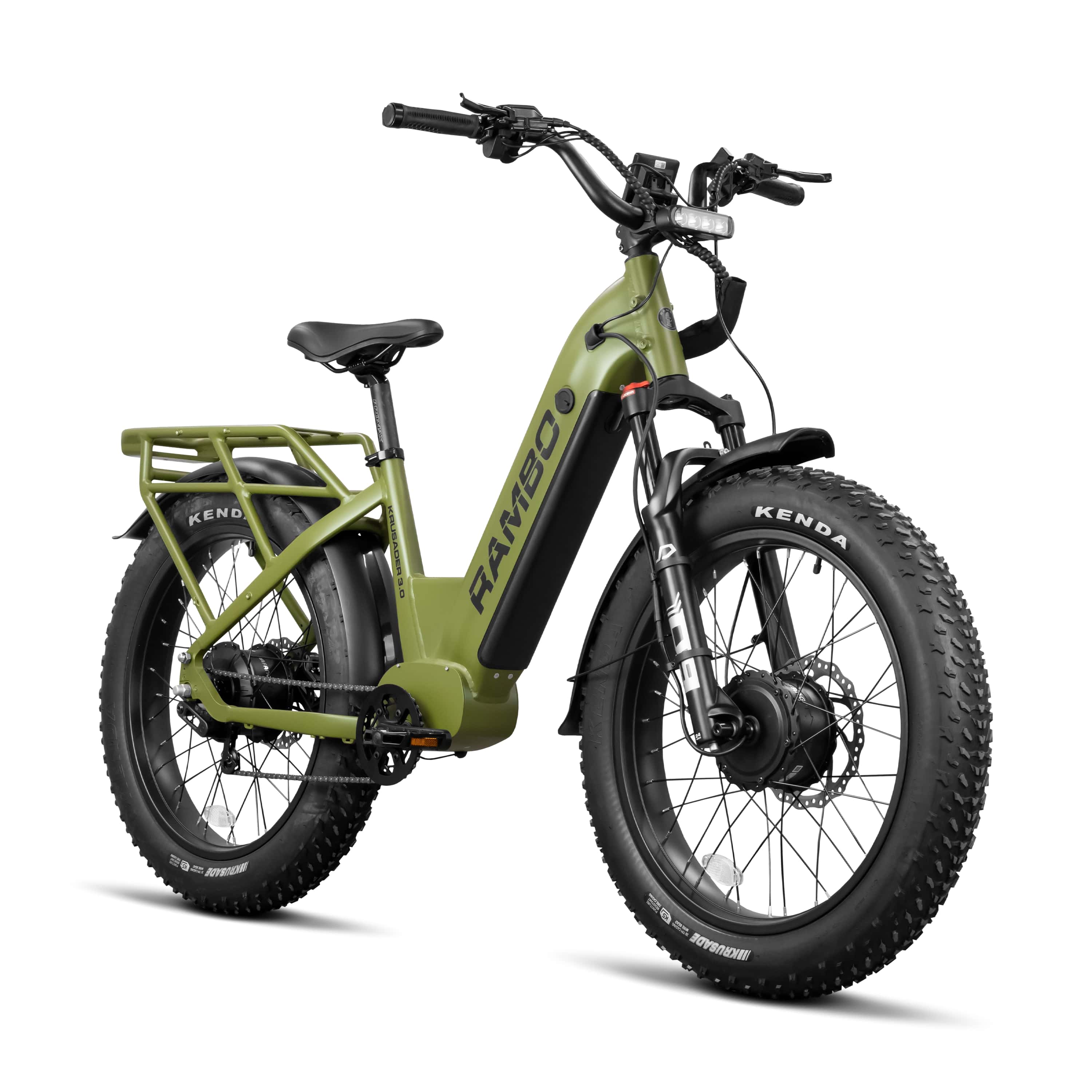
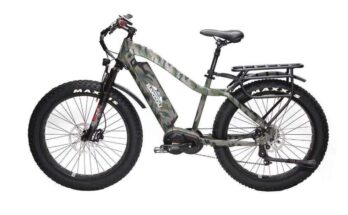
Rambo Krusader 3.0 AWD – $2,969.99
The Rambo Krusader 3.0 AWD runs dual 500W hub motors (front and rear) with 26×4-inch fat tires. It is the most affordable AWD hunting eBike from a reputable brand, coming in under $3,000 with a 15Ah battery. Available in OD Green and Mossy Oak Bottomland camo, it integrates with Rambo’s trailer and accessory ecosystem. The dual hub motor setup is simple and reliable, and you can run single or dual motor depending on conditions. Range takes a hit when running both motors, so the 20Ah battery option ($3,299.99) is worth the upgrade if you plan to use AWD frequently.
Budget Dual Motor Options
Several Chinese-manufactured dual motor fat tire eBikes are available in the $1,500-2,500 range. These offer impressive specifications on paper, but the build quality, motor reliability, and after-sales support vary dramatically. If you’re considering a budget dual motor option, research the specific brand and model thoroughly. Look for user reviews from people who have put serious miles on the bike, not just unboxing videos. At this price point, you’re gambling on components and customer support, so go in with realistic expectations.
The Tradeoffs: Weight, Cost, and Complexity
Weight
This is the biggest practical tradeoff. A second motor and its associated wiring add 12-20 pounds to your eBike. A dual motor hunting eBike with a full battery can weigh 85-100+ pounds. That weight matters when you’re loading the bike onto a truck rack, lifting it over obstacles on the trail, or dealing with a mechanical failure miles from the trailhead. More weight also means more tire wear, more brake wear, and more stress on every component.
Cost
AWD systems add $500-1,500 to the price of a comparable single-motor eBike. At the premium end, you might be looking at $5,000-7,000+ for a quality AWD hunting eBike. That’s a significant investment, and you need to honestly assess whether the terrain you hunt justifies it.
Battery Range
Two motors consume more power than one. Simple physics. Running both motors drops your effective range by 30-50% compared to single-motor operation. Most AWD eBikes address this with larger batteries, but larger batteries add more weight (see above). The practical solution is running in single-motor mode on easier terrain and engaging AWD only when needed, but that requires discipline and trail knowledge.
Complexity and Reliability
More components mean more potential failure points. A second motor means a second controller, additional wiring, and more connections exposed to mud, water, and vibration. If a single-motor eBike fails in the field, you can still pedal it home (with difficulty, given the weight). If a dual-motor eBike has a controller failure, you might be dealing with a motor that’s locked up rather than just not assisting, which could make the bike unrideable.
The Practical Western Hunter’s Take
Here’s my honest assessment after riding both single-motor and dual-motor eBikes in mountain terrain across Montana, Idaho, and Wyoming. If your main concern is climbing steep hills and hauling heavy loads, a quality single-motor mid-drive eBike is the better tool. A Bafang Ultra mid-drive working through your bike’s gears delivers more usable torque on a steep climb than two hub motors ever will, and it does it with less weight and better battery efficiency. For pure climbing power and heavy pack-outs, a mid-drive from Bakcou or Rambo is the right call.
AWD solves a different problem. It is for the rider who encounters mud, snow, sand, and loose gravel where the rear wheel loses traction and spins. In those conditions, having power to both wheels saves the day. When your rear tire is spinning on a slick clay hill, a front hub motor pulling you forward is the difference between making it and walking. If your hunting land regularly puts you in those traction-limited situations, AWD is worth the extra weight and cost.
Know which problem you are solving before you spend the money. If it is power and climbing, go mid-drive. If it is traction on slippery surfaces, go AWD.